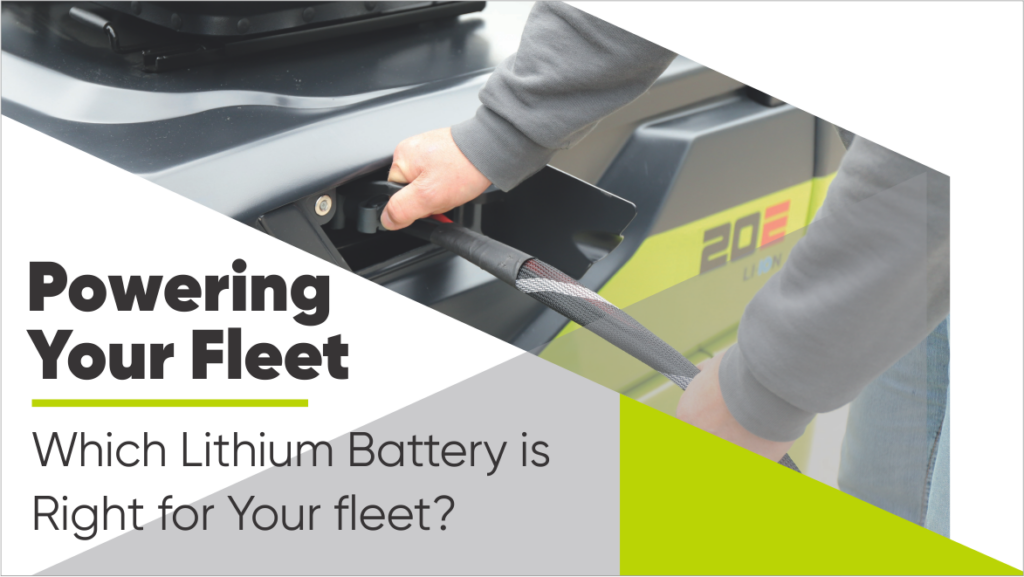
Transitioning a material handling fleet to lithium-ion technology eliminates watering schedules, acid corrosion, and long equalization cycles. However, selecting the correct system voltage—24V, 36V, 48V, or 80V—is critical to maximizing operating efficiency, truck performance, and ROI.
Voltage Profiles & Applications
| Voltage | Equipment Types | Typical Capacity | Best Suited For | Key Operational Advantage |
| 24V | Walkie stackers, end-riders, electric pallet jacks | 150Ah – 350Ah | Light-duty retail, short runs, tight aisles | Compact footprint, lower initial investment, easy opportunity charging |
| 36V | Reach trucks, order pickers, stand-up counterbalanced | 360Ah – 525Ah | High-bay distribution, narrow-aisle warehousing | Strong balance of lift speed, thermal management, and multi-shift endurance |
| 48V | Sit-down counterbalanced (3,000–6,000 lb capacity) | 420Ah – 700Ah | Medium-to-heavy manufacturing, high-throughput logistics | The industry standard for indoor/outdoor versatility and heavy lifting |
| 80V | Large counterbalanced trucks (6,000–20,000+ lb capacity) | 460Ah – 1,050Ah+ | Steel mills, paper mills, ports, heavy manufacturing | Maximum acceleration, low current draw, heat reduction under severe continuous loads |
Understanding the Electrical Advantage
Voltage ($V$) dictates how efficiently power ($P$, measured in Watts) is delivered to your traction and hydraulic motors:
Higher system voltage allows the forklift to deliver the same power using less current ($I$, measured in Amperes). Because electrical heat losses scale exponentially with current ($P_{\text{loss}} = I^2 R$), an 80V system operates cooler, pulls less amperage, and maintains higher sustained travel and lift speeds under heavy loads compared to a 48V system doing the same work.
5 Decision Criteria for Your Fleet
When evaluating voltage requirements, match the power platform to your facility’s operational profile:
-
Equipment OEM Specifications & Data Plate:
Your lift truck’s traction motor, hydraulic pump, and motor controller are engineered for a specific nominal voltage. Installing a mismatched voltage damages electronics and voids OEM warranties.
-
Minimum Counterweight Requirements:
Lithium-ion batteries are significantly lighter than lead-acid batteries. Because forklifts rely on battery mass as part of their counterweight, replacing a heavy lead-acid pack with a lightweight lithium unit can alter the truck’s center of gravity and compromise stability. Ensure the lithium battery supplier includes integrated steel ballast plates if necessary to meet OSHA safety standards and truck minimum weight specs.
-
Throughput and Thermal Load:
Single-shift, light-duty facilities run reliably on 24V or 36V platforms. However, high-throughput 24/7 operations moving heavy loads up steep ramps or lifting over 20 feet benefit from 48V or 80V architectures, which resist heat buildup during fast opportunity charging.
-
CAN-Bus Integration & Communications:
A lithium battery should not act as an isolated component. Ensure the battery’s internal Battery Management System (BMS) communicates directly with the forklift’s controller via CAN-bus. This allows accurate State-of-Charge (SOC) monitoring on the dashboard display and automatic power throttling before low-voltage shutdowns occur.
-
Charger Infrastructure & Opportunity Charging:
Lithium performance relies on fast opportunity charging during breaks. Verify that your electrical service supports the high-amperage output required by high-voltage chargers (e.g., an 80V charger drawing significant 480V 3-phase AC power) to reach full charge in 1–2 hours.
Partnering for Maximum Fleet Efficiency
Navigating the transition to lithium-ion power doesn’t have to be complex when you have the right local expertise behind you. As Northeast Ohio’s full-service material handling dealership, All Lift Service Company is dedicated to helping businesses throughout the Cleveland metro area optimize their fleet performance. From evaluating your operational demands to matching the exact 24V, 36V, 48V, or 80V lithium forklift, battery, and charger setup to your application, our team provides complete end-to-end support. We handle everything from professional charger installation to ongoing planned maintenance and service to keep your electric fleet operating at peak efficiency. Contact the specialists at All Lift Service Company today, or just call us at 440-585-1542 to request a fleet consultation and discover the ideal electric energy solution for your facility.